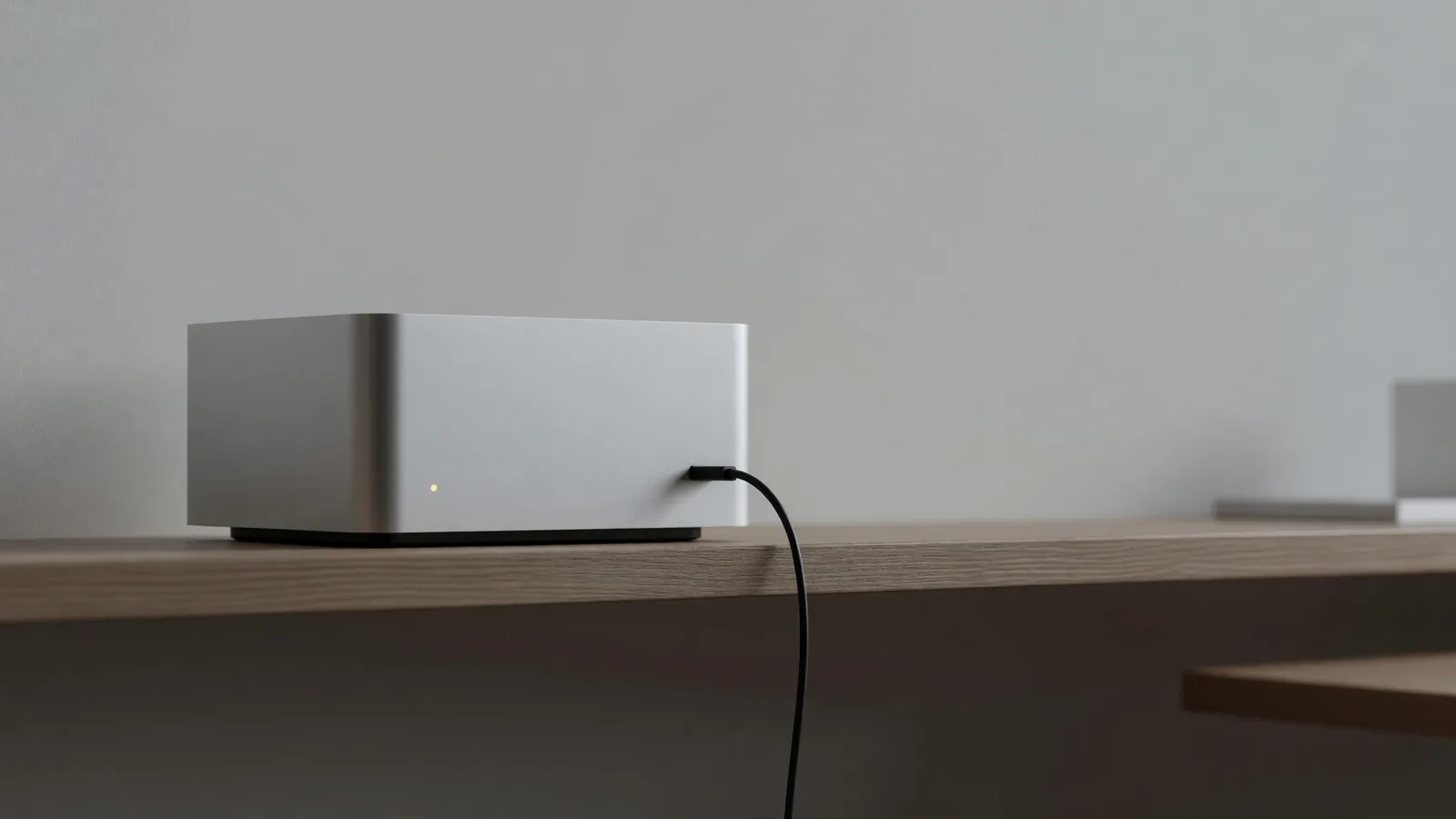
Sigil Wen's Conway Research launched Underdog on October 2, a personal AI assistant that runs entirely on Apple-silicon Macs rather than a cloud server, with Andreessen Horowitz announcing it is leading the lab's first round. It is the strongest consumer-facing datapoint yet that a 27B-class model can run everyday assistant work on hardware you already own.
Key facts
- Underdog runs on Apple-silicon Macs today, with iPhone, iPad, Windows, Android, and Linux builds on a waitlist, in an invite-only beta.
- Andreessen Horowitz announced on October 2, 2026 that it is leading Conway Research's first funding round; the round size was not disclosed.
- Conway's model lineup includes Woof, a 4-billion-parameter model under 2.5GB, and Underdog 27B, which Conway says is designed to outperform frontier models such as Claude Opus 4.6 on certain benchmarks — a vendor claim.
- Conway says its custom Apple-silicon inference engines run up to 4.5x faster than Apple's MLX framework and reach 730 tokens per second on MacBooks — also unverified vendor claims.
- The smallest model takes up less than 4GB on the user's computer, per the product site.
What happened
Conway Research, the AI lab founded by 2025 Thiel Fellow Sigil Wen, shipped the public beta of Underdog, a personal assistant that handles email, calendar, meeting notes, dictation, and browser-driven errands like booking flights or canceling subscriptions. The product's distinguishing constraint is where it runs: the site states the model lives on your computer, not in a data center, with Gmail and Outlook credentials stored locally and browser actions gated behind user approval. Wen announced the launch and backing on X on October 2, and Andreessen Horowitz published a launch announcement the same day confirming it leads the round.
The a16z post is candid about the motivation: as assistants move from answering questions to acting on your behalf, they need access to your conversations, documents, and preferences — the same material you most need to protect. Underdog's answer is to keep that material on the device. The site describes local meeting-note transcription, on-device dictation in any app, and an agent that uses your Chrome browser to book flights or order groceries, asking approval before it buys anything.
Two things make this more than a product launch. First, the backer table: a16z leading, with Khosla Ventures, Hummingbird VC, and angels including Patrick Collison, Naval Ravikant, and Guillermo Rauch cited in the launch thread. Second, the ambition framing. Wen's announcement introduced what he calls "Underdog's Law" — the claim that today's frontier intelligence reaches your devices in about six months. That is a thesis, not a measurement, and no benchmarks were published in the launch material.
Conway also says it built custom inference engines tuned for Apple silicon, which it claims run up to 4.5x faster than Apple's MLX framework, processing up to 730 tokens per second on MacBooks. Treat all of it — the 27B benchmark claims, the throughput numbers, the "no data leaves the device" guarantee — as the company's self-description until an independent party can inspect the model card, the weights, or the network traffic.
Why it matters
For builders deciding where to run models, Underdog is a datapoint in the argument over whether personal-assistant workloads need a cloud tenant at all. The economic logic is straightforward: running models locally shifts compute costs onto hardware the user already owns, which is how a startup can offer a capable assistant for free. The privacy logic is structural: there is no server breach to fear if no server ever sees the data.
That matters because the closed-API privacy floor keeps shifting in ways users do not control. OpenAI is rolling out Private Safety Processing on top of Zero Data Retention, and Anthropic retains prompts for 30 days on Covered Models. Against that baseline, an assistant with no server to subpoena or breach is a different architectural bet — and top-tier venture money just endorsed it.
It also matters because the verification gap is real. Every capability claim here is unfalsifiable until weights or an eval harness are public. What would verify the story: a published model card for Woof and Underdog 27B, independent on-device benchmarks against MLX baselines, and a network-traffic audit of the "100% local" claim.
Background
On-device personal AI has been creeping up the capability curve for three years. Whisper-class speech models made local transcription normal; Apple Intelligence normalized on-device summarization; and the open-weights ecosystem keeps pushing usable capability down the parameter ladder — 4B coding agents and 27B-class generalists now run on consumer machines. Conway's contribution is packaging: an assistant that treats local-first as the product rather than a fallback.
The financing is the signal. a16z's crypto division, led by Chris Dixon, wrote the check, which is notable: the firm that bet on decentralized infrastructure is also betting that the cheapest private inference is the inference that never leaves your desk. Those two bets converge — local devices handle the personal layer, and decentralized marketplaces and confidential-compute providers compete for everything that does not fit in unified memory.
Hardware fit is the constraint to watch. A 27B model in a usable quantization wants 24GB-plus of unified memory, which is why Underdog ships Mac-first. Apple's silicon roadmap keeps widening that lane: the 512GB M5 Ultra Mac Studio due late October is the only consumer box that fits 120B+ open-weight models without a cluster. If Underdog's engine claims hold up, the same class of tuned Apple-silicon inference could power a wave of local-first consumer products.
What's next
The invite-only beta is open for Apple-silicon Macs now, with iPhone, iPad, Windows, Android, and Linux builds on a waitlist. Watch three things: whether Conway publishes model cards or benchmarks for Woof and Underdog 27B; whether the iPhone build ships on the promised timeline, which would test whether phone-class memory can hold the assistant; and whether independent labs replicate the 4.5x-over-MLX claim. If the open-weights ecosystem keeps improving at the current pace, Wen's six-month "Underdog's Law" will get tested against real releases within two quarters.
Questions
- What is Underdog by Conway Research?
- Underdog is a personal AI assistant from Conway Research, the lab founded by Sigil Wen. It runs entirely on your own Apple-silicon Mac — email, calendar, meeting notes, dictation, and browser-driven errands with user approval — with no data sent to external servers, according to the company. An invite-only beta is available for Apple-silicon Macs.
- Who is funding Conway Research?
- Andreessen Horowitz said on October 2, 2026 that it is leading Conway Research's first funding round. An X announcement cited Khosla Ventures, Hummingbird VC, and angels including Patrick Collison and Naval Ravikant. The round size was not disclosed.
- Does Underdog send your data to the cloud?
- Conway states that Underdog keeps email, audio transcripts, and other content on the device, with credentials stored locally. The privacy properties are the company's own claims; no independent audit or published model card verified them as of October 3, 2026.
- Is Underdog free?
- Underdog's site pitches the assistant as free, which works economically because inference runs on hardware the user already owns rather than on the provider's servers. Pricing for future tiers or the commercial model licensing has not been published.
Sources
- Investing in Conway, the Creator of Underdog — Andreessen Horowitz
- Underdog — product site — Conway Research
- a16z backs Conway's Underdog, an AI that runs entirely on your device — Dealroom
About DeAI
DeAI is an independent publication covering open-weight AI models, private inference, and decentralized infrastructure — the tools for running AI you actually control. We test providers on price, privacy, and refusal behavior and publish the numbers, not the vibes. DeAI is powered by Morpheus (mor.org), a decentralized inference marketplace, and covers it on the same terms as every other provider.
Powered by Morpheus and StrandCMS
Morpheus is a decentralized inference marketplace, covered on the same terms as every other provider — we rank it wherever the data lands. StrandCMS is the open-source, agent-first framework this site is built on.