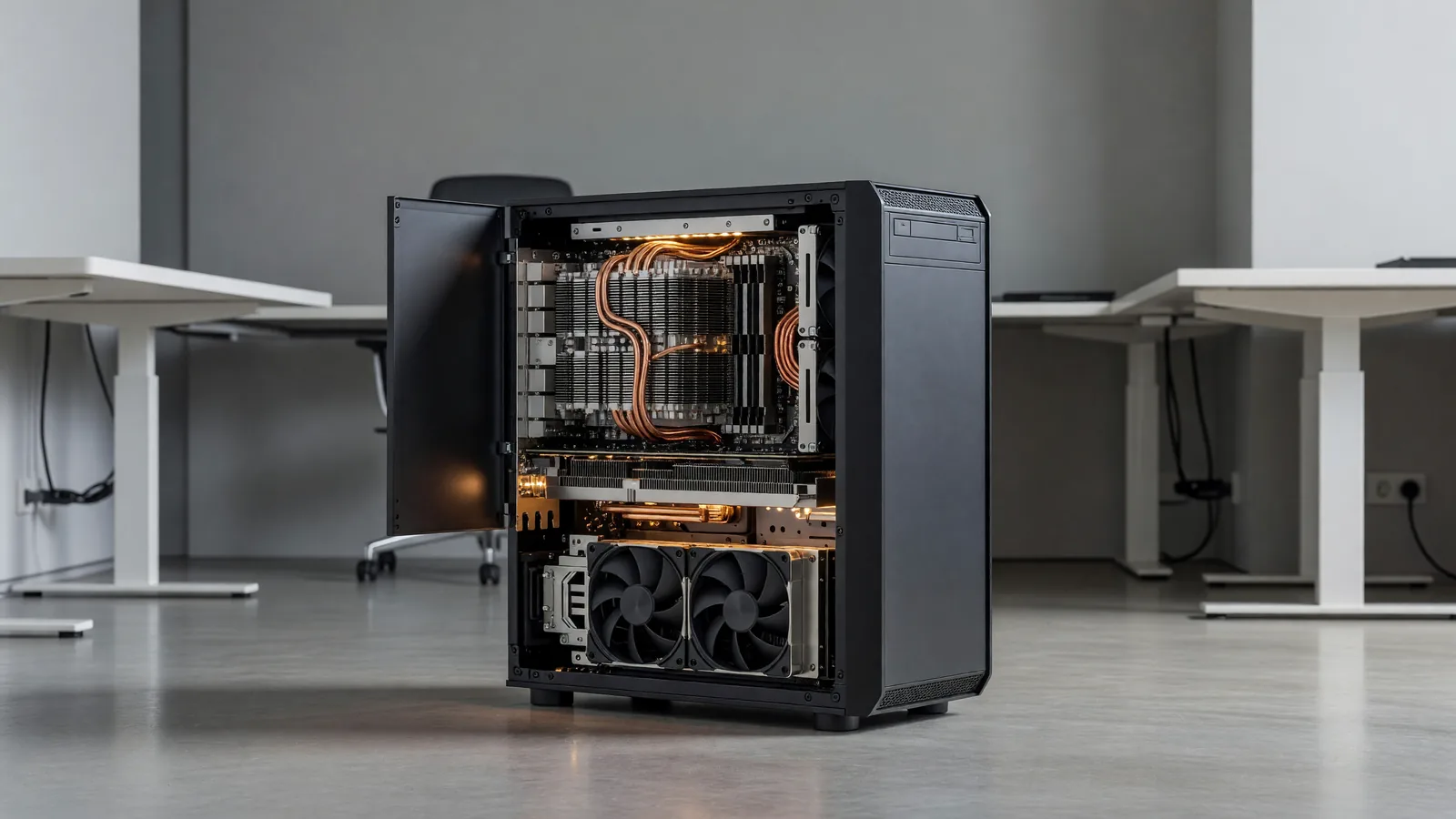
Black Forest Labs' FLUX.3 Image Klein now has linked open checkpoints and a working Diffusers integration, moving the release beyond the earlier promise of open weights. Hugging Face documents text-to-image, reference-image editing, and bounding-box layout control. Its measurements also show why consumer-GPU claims need qualification.
Key facts
- The integration guide links distilled and base checkpoints; their default generation settings are 16 steps without classifier-free guidance and 50 steps with it, respectively.
- Hugging Face reports 1.93 seconds for a 1024-by-1024 text-to-image run on an H100, averaged after warmup, with no offloading.
- The guide's memory table lists 15.3 GiB peak allocated after inference for its NVFP4 RTX6000 setup, versus 20.72 GiB for its BF16 H100 setup.
- Layout boxes use y-first coordinates on a normalized 0–1000 scale, rather than ordinary pixel positions.
From a promise to a deployment recipe
DeAI previously covered the FLUX 3 Image announcement when open weights were still promised. The October 16 RSS collection caught the Klein integration guide. The new reportable development is the linked checkpoints and documented serving path, rather than a second announcement of the earlier hosted model.
The Diffusers guide uses its ModularPipeline interface. It provides examples for generating an image, conditioning a generation on references, and moving a region in an existing image. It also describes LoRA training scripts for text-to-image and instruction-based editing.
These are useful artifacts for a team building a controlled image workflow. The distilled model is the fast inference path in the examples; the base is the recommended fine-tuning starting point. An application should not silently substitute one for the other and expect the same settings, generation time, or adaptation behavior.
This review could retrieve the public guide but not the gated checkpoint README without authorization. It therefore does not assert a specific commercial license for either checkpoint. Download availability, acceptance requirements, and the terms attached to the chosen files need to be checked together before deployment.
Layout control has a concrete interface
The guide's region interface attaches an identifier, bounding box, and description to a scene. For edits, it maps a source box in a reference image to a target box in the output. Regions that should stay in place can be assigned unchanged source and target positions.
For developers, the coordinate order is an easy integration trap. The documented order is [y_min, x_min, y_max, x_max], and the coordinates are normalized rather than measured in output pixels. A conventional graphics interface that exports x-first pixel rectangles needs an explicit conversion before passing them to this pipeline.
The examples show intended behavior, not a guarantee of exact pixel preservation for every request. A production review should check the generated result against the source for unintended movement, changed identity, and altered background detail. Region instructions improve the interface for expressing an edit; they do not replace output inspection.
Memory and latency are different claims
Some release coverage emphasizes small consumer GPUs. The retrieved primary integration guide gives a more specific basis for planning: quantized memory measurements on named hardware, alongside separate full-pipeline timing measurements on an H100. Its no-offload timing table reports a higher peak memory figure than the earlier component-oriented memory table. These entries describe different setups and should not be collapsed into a single minimum requirement.
The guide describes CPU offloading, freeing the text encoder after prompt encoding, and using quantized transformer weights to reduce memory. It explicitly says the automatic offloading path was not benchmarked. Those options are plausible deployment paths, but they do not establish a measured speed on a low-memory desktop.
Quantization also has a hardware distinction. Hugging Face says the fast NVFP4 kernels target Blackwell, while its FP8 rowwise path has a different accelerator requirement. On other GPUs, dequantizing weights can save memory without delivering the same speedup. The ability to load a format is not evidence that the hardware executes it natively.
Reference images add work as well. The timing table shows image-conditioned generation taking longer than text-only generation. Testing only empty-reference requests would miss the cost of the editing workflow the product actually intends to offer.
Background and what to measure next
The model hub follows when model artifacts become usable, while DeAI's open-weight versus open-source guide explains why the license still needs a separate check. The self-hosting cost guide adds utilization and operational overhead to the hardware decision.
For Klein, an informative local test should preserve the checkpoint, precision, attention backend, image dimensions, reference count, and whether the text encoder is resident. Measure the whole request, including encoding and decoding, rather than just denoising. Test editing cases separately from new-image generation.
The release gives builders more control over composition and a documented route to running the model themselves. The next useful evidence is measured behavior on the intended machine, under the license attached to the acquired checkpoint. That is a stronger deployment basis than treating an offloading suggestion or a datacenter timing as a consumer-GPU guarantee.
Questions
- What does FLUX.3 Image Klein's layout control do?
- It lets prompts specify regions with normalized bounding boxes, and editing prompts map source regions to target positions. Diffusers documents the coordinates in y-first order.
- Does the FLUX.3 guide prove it runs in 8 GB?
- No. The retrieved guide's quantified memory table lists 15.3 GiB peak after inference for its NVFP4 RTX6000 setup. It describes offloading options but says those were not benchmarked.
Sources
- Welcome FLUX.3 Image Klein in Diffusers — Hugging Face
About DeAI
DeAI is an independent publication covering open-weight AI models, private inference, and decentralized infrastructure — the tools for running AI you actually control. We test providers on price, privacy, and refusal behavior and publish the numbers, not the vibes. DeAI is powered by Morpheus (mor.org), a decentralized inference marketplace, and covers it on the same terms as every other provider.
Powered by Morpheus and StrandCMS
Morpheus is a decentralized inference marketplace, covered on the same terms as every other provider — we rank it wherever the data lands. StrandCMS is the open-source, agent-first framework this site is built on.