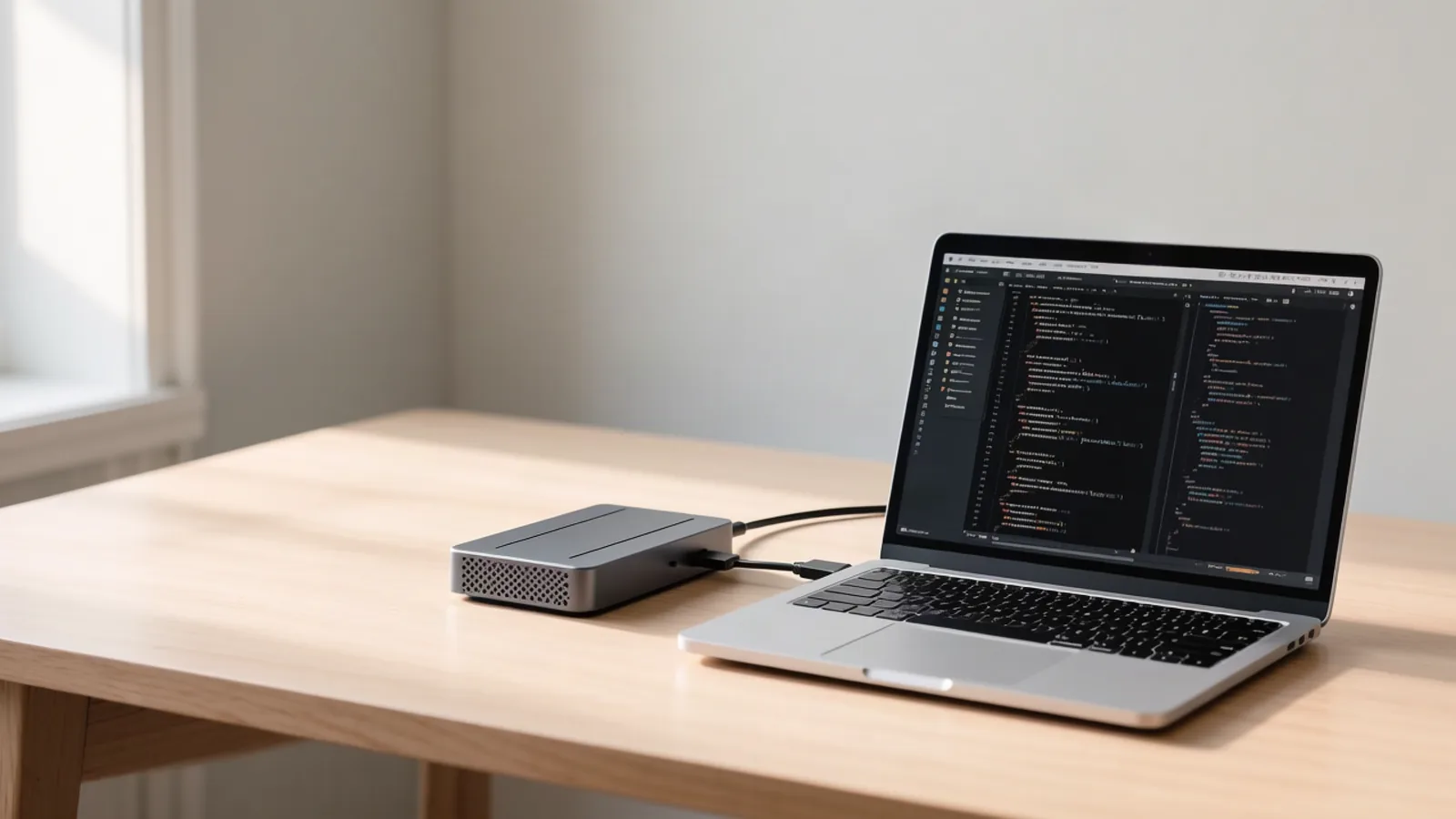
Recursive shipped Flint on October 21: an Apache-2.0 open-weights mixture-of-experts coder, 39.8B total parameters with about 2.5B active per token, built for agentic coding on local hardware. CEO Richard Socher's launch post pulled roughly 5,300 likes and 1.97 million views in the first sweep. The benchmarks making the rounds are all Recursive's own measurements.
Key facts
- The Flint model card documents 39.8B total / ~2.5B active parameters, 256 routed experts plus a shared expert, 262,144-token documented context, a BF16 checkpoint and an SGLang serving kit; the repo's license field states Apache-2.0.
- Company-reported scores: 89.7% SWE-bench Pro v2, 54.9% Terminal-Bench 2.1, 74.2% SWE-bench Verified, each marked with a dagger as Recursive-measured.
- The launch post claims 125+ tokens per second on an M4 Pro MacBook Pro and 150+ on a 64GB NVIDIA RTX Spark, at short contexts, with the company's optimized engine.
- Socher's launch post on X drew about 5.3k likes and 1.97M views per the point-in-time sweep.
- Twelve quantized variants are already listed for llama.cpp, LM Studio, Jan and Ollama, the day after release.
What's driving the conversation
Socher's post framed Flint around two hooks at once: local coding performance per watt, and the story that Recursive's automated research system, the Eureka Machine, built nearly the whole stack in under four months. Reply threads split between people running the quantizations on Apple Silicon within hours and people pointing out that every headline number carries a dagger and a footnote. Both camps have a point.
The substance
The release itself is real and checkable: weights, config, serving kit and quantizations are on Hugging Face, the repo license field states Apache-2.0, and the card's spec table is unusually complete, down to the sliding-window size (513 tokens) and per-head attention sinks. Serving targets are one B300 or H200 per replica, with Transformers modeling code not yet included.
The performance claims need their footnotes. The card states that agentic scores average pass@1 over at least five attempts, that Terminal-Bench uses the Terminus 2 harness with retrieval-derived solutions counted as failures, and that comparison scores for other models are developer-reported, under different setups. The card says so itself; the viral posts mostly do not. The speed figures come from Recursive's optimized engine at short contexts, not from the SGLang kit on stock tooling. The "built in under four months by the Eureka Machine" line is the company's own account of its internal process, unfalsifiable from the outside and best read as marketing for Recursive's automation platform.
Why builders are watching
The interesting datapoint is where the efficiency lands: near-3B active parameters doing agentic coding work at claimed laptop speeds puts Flint in direct conversation with the small-MoE local-agent wave, alongside Liquid AI's LFM2.5-24B. If the numbers survive independent reproduction, running a capable coding agent fully offline stops being a compromise play. If they do not, the dagger footnotes were doing their job. Either way, an Apache-2.0 license on the repo makes the reproduction possible in a way closed releases are not, and the self-hosting economics behind running versus renting get a new data point every time a model like this ships.
Watch for independent evals of the released checkpoint, upstream serving support beyond SGLang, and whether Recursive publishes the harness configs for third-party verification.
Questions
- What is Recursive Flint?
- Flint is Recursive's mixture-of-experts language model for coding agents: 39.8B total parameters with about 2.5B active per token, an Apache-2.0 license on the Hugging Face repo, a BF16 checkpoint, and an SGLang serving kit. It is documented at 262,144-token context, with company-reported scores of 74.2% SWE-bench Verified and 89.7% SWE-bench Pro v2.
- Are Flint's benchmark numbers independent?
- No. The headline scores (89.7% SWE-bench Pro v2, 54.9% Terminal-Bench 2.1, 74.2% SWE-bench Verified) and the speed figures (125+ tok/s on an M4 Pro, 150+ on an RTX Spark) are Recursive self-measurements, marked with a dagger in the model card, and comparison scores for rival models are developer-reported under different eval setups.
Sources
- RecursiveSI/flint model card — Hugging Face
- Introducing Flint — Recursive
- X — Richard Socher launch post — X
- Recursive Flint: local coding model coverage — MarkTechPost
About DeAI
DeAI is an independent publication covering open-weight AI models, private inference, and decentralized infrastructure — the tools for running AI you actually control. We test providers on price, privacy, and refusal behavior and publish the numbers, not the vibes. DeAI is powered by Morpheus (mor.org), a decentralized inference marketplace, and covers it on the same terms as every other provider.
Powered by Morpheus and StrandCMS
Morpheus is a decentralized inference marketplace, covered on the same terms as every other provider — we rank it wherever the data lands. StrandCMS is the open-source, agent-first framework this site is built on.