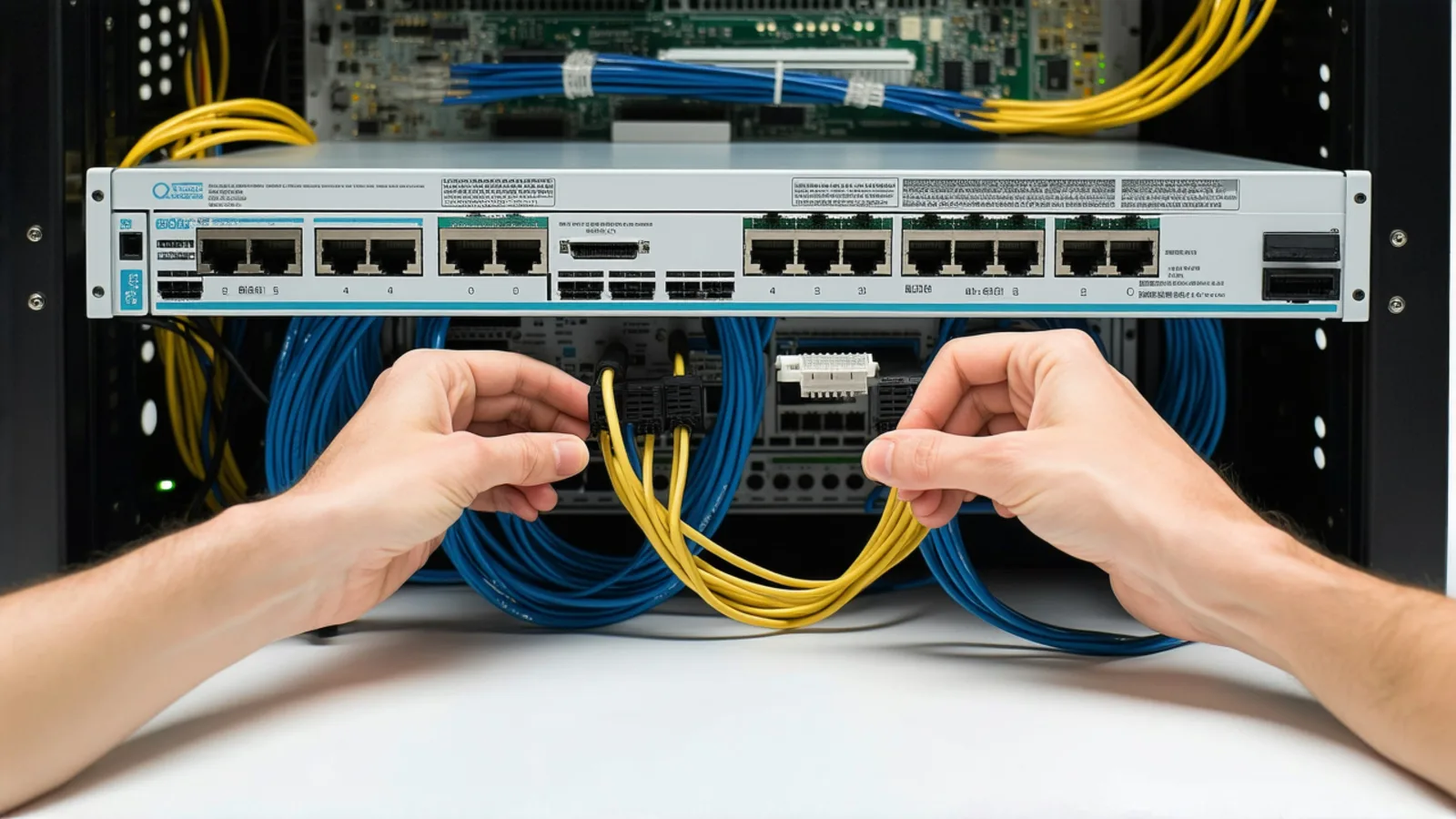
You can run DeepSeek V4 Pro through the official DeepSeek API, third-party OpenAI-compatible hosts, aggregators, decentralized marketplaces, or your own hardware. DeepSeek reports 80.6% on SWE-bench Verified (self-reported, as of 2026-08-20). This guide compares every hosting route on jurisdiction, pricing model, and setup effort, with copy-paste code for each.
Key takeaways
- DeepSeek self-reports 80.6% on SWE-bench Verified for V4 Pro (as of 2026-08-20) — a vendor claim, not an independent result.
- Five hosting routes exist: official API, third-party serverless hosts, aggregators, decentralized marketplaces, and self-hosting. Nearly all expose an OpenAI-compatible endpoint, so switching is a two-line change.
- The official API is operated from China, and DeepSeek's privacy policy states user data is stored on servers there; third-party hosts run the same open weights on their own infrastructure.
- No prices are compared in this guide because every host sets its own per-token rates; verify on each provider's pricing page before committing.
- SWE-bench Verified is a 500-task benchmark; one score never captures latency, tool-use reliability, or refusal behavior.
What is DeepSeek V4 Pro?
DeepSeek V4 Pro is the flagship open-weight release in DeepSeek's V4 line, aimed primarily at agentic coding and tool-use workloads. The headline number: DeepSeek reports 80.6% on SWE-bench Verified, self-reported as of 2026-08-20. SWE-bench Verified is a 500-task, human-validated benchmark built from real GitHub issues, so if the figure holds up under independent reproduction, it places V4 Pro in frontier coding territory.
Treat it as a vendor claim for now. Third-party evaluators typically need weeks to replicate scaffolding, prompts, and sandbox setup before confirming or discounting a self-reported score. For side-by-side context against other open-weight releases, see the model directory. Separately, DeAI's refusal-index methodology scores how often hosted models decline benign requests; V4 Pro entries will appear as runs complete.
Where can you run the DeepSeek V4 API?
Because the weights are open, "the DeepSeek V4 API" is not one endpoint. There are five distinct routes, each with different jurisdiction, billing, and data-handling properties.
| Route | Examples | Jurisdiction | Pricing model | Setup effort |
|---|---|---|---|---|
| Official DeepSeek API | api.deepseek.com | China; DeepSeek's privacy policy states data is stored on servers there | Per-token, published on DeepSeek's docs | Lowest |
| Third-party serverless hosts | Together AI, Fireworks AI, Novita AI, Hyperbolic, Cerebras, SambaNova | US / EU / varies by provider | Per-token (some per-GPU-second); each publishes a pricing page | Low |
| Aggregators | OpenRouter | Depends on the upstream you select | Per-token pass-through plus a margin | Low |
| Decentralized marketplaces | Morpheus | Varies by operator | Market-set per-token | Low–medium |
| Self-hosting | Your GPUs or rented bare metal | Yours | GPU-hours only | High |
The official DeepSeek API
The first-party endpoint at api.deepseek.com is OpenAI-compatible and historically the first place new DeepSeek features (context caching, off-peak discount windows) appear. The exact V4 Pro model slug, rate limits, and current pricing live on DeepSeek's API docs. The trade-offs are jurisdiction (covered below) and, for some teams, procurement and payment friction from certain regions. If neither affects you, it is the simplest path to the model.
Third-party hosted providers
Because V4 Pro ships as open weights, US- and EU-based inference providers can serve it on their own infrastructure. Together AI, Fireworks AI, Novita AI, Hyperbolic, Cerebras, and SambaNova have all hosted DeepSeek open-weight releases; whether each carries the exact V4 Pro checkpoint changes week to week, so check their current model lists. Most expose OpenAI-compatible endpoints and publish per-token pricing pages; some also sell dedicated throughput for production workloads. Data handling is governed by each provider's retention policy, and any "zero-retention" language is a policy statement, not an independently verified fact.
Aggregators
OpenRouter sits in front of multiple upstreams: one API key, one bill, and the ability to pin or exclude providers by region. That makes it the fastest way to compare hosts serving identical weights, at the cost of a per-token margin and an extra party in the request path. If you use an aggregator for failover, read its data-policy page: your prompts transit the aggregator before reaching the upstream provider.
Decentralized marketplaces
Morpheus, a decentralized inference marketplace, routes requests to independent operators rather than a single company's data centers. Pricing is market-set, and jurisdiction depends on which operator actually serves your request, a property to evaluate per workload, not assume. As with every host in this guide, retention and privacy terms are claims made by the operator or marketplace, not facts DeAI has verified. The category's practical appeal is permissionless access and provider diversity; the practical cost is that guarantees vary operator by operator.
Self-hosting
Weights are distributed through DeepSeek's Hugging Face organization, where the model card carries license terms and hardware guidance. Serve them with vLLM or SGLang. Both expose an OpenAI-compatible server, so downstream code looks identical to any hosted option. Self-hosting converts per-token spend into GPU-hours and gives you full control over logs and retention, at the price of owning capacity planning, quantization trade-offs, and uptime. For steady, high-volume workloads it often pencils out; for bursty traffic, hosted is simpler.
How do you call the DeepSeek V4 API?
Every hosted route above speaks the OpenAI chat-completions schema, so integration is a three-line change: base URL, API key, model slug. Model slugs differ per host, so copy the exact string from your provider's docs.
Python, using the official OpenAI SDK:
from openai import OpenAI

client = OpenAI(
    base_url="https://api.deepseek.com",  # swap for your host's endpoint
    api_key="YOUR_API_KEY",
)

response = client.chat.completions.create(
    model="deepseek-v4-pro",  # use your host's exact model slug
    messages=[{"role": "user", "content": "Refactor this function for O(n) time."}],
    temperature=0.2,
)

print(response.choices[0].message.content)
The same call with curl:
curl https://api.deepseek.com/chat/completions \
  -H "Authorization: Bearer $API_KEY" \
  -H "Content-Type: application/json" \
  -d '{
    "model": "deepseek-v4-pro",
    "messages": [{"role": "user", "content": "Refactor this function for O(n) time."}]
  }'
For self-hosting, point base_url at http://localhost:8000/v1 once your vLLM or SGLang server is up; the request body is unchanged.
Can you use DeepSeek V4 without the China-based official API?
Yes. That is the practical consequence of open weights. DeepSeek's own privacy policy states that user data is stored on servers in China; that is a policy statement from the vendor, and it is the fact most compliance teams anchor on. If your organization answers to GDPR, data-residency clauses, or customer contracts that restrict where prompts are processed, the official API may fail review regardless of model quality.
The alternatives keep the weights and change the operator: third-party hosts in the US or EU, aggregators pinned to specific regions, decentralized marketplaces (where operator jurisdiction varies), or self-hosting in your own cloud. One nuance worth stating plainly: routing around the official API changes who processes your data, not who built the model. For most regulatory regimes, inference location and prompt handling are what matter, but confirm that with your counsel, not with a blog post. DeAI breaks these trade-offs down in detail in DeepSeek API: official vs. third-party.
How much does the DeepSeek V4 Pro API cost?
There is no single price: every host sets its own per-token rates, and DeAI does not republish figures that change weekly. Three reliable rules of thumb. First, open-weight models typically run at a fraction of frontier closed-API pricing, regardless of host. Second, the official API has historically posted very low list prices relative to closed frontier APIs, with context-caching and off-peak mechanics described on DeepSeek's docs; verify current numbers there. Third, aggregators add a margin on upstream rates, while self-hosting converts the question into GPU-hours.
The only comparison that matters is on your own token mix: input-to-output ratio, cache hit rate, and peak concurrency. Pull each provider's pricing page (linked in the sources) and run your real traffic profile against it.
How to choose a host: five checks
- Jurisdiction first. If the official API fails compliance review, shortlist only hosts in acceptable regions. This single filter usually halves the field.
- Confirm the exact checkpoint. "DeepSeek V4" listings can mean different variants; verify the provider serves V4 Pro, not a smaller sibling.
- Price your real traffic. Input-heavy RAG and output-heavy codegen bill very differently; model your input:output ratio against each pricing page.
- Test rate limits before migrating. Per-minute token caps and burst behavior differ widely across hosts, and they are rarely on the marketing page.
- Treat privacy terms as policy statements. Zero-retention and "operators can't see prompts" language is a claim to weigh in your risk review, not a verified property.
FAQ
How much does the DeepSeek V4 Pro API cost?
Pricing is per token and set by each host. DeepSeek publishes its rates on its API docs; third-party hosts and aggregators publish their own pricing pages. Open-weight models typically run at a fraction of frontier closed-API pricing, so compare on your real input:output mix.
Can I use DeepSeek V4 without the China-based official API?
Yes. Because V4 Pro ships as open weights, third-party hosts in the US and EU, aggregators, decentralized marketplaces, and self-hosting all serve the model without routing prompts through DeepSeek's official API. Jurisdiction then depends on the operator you choose.
What is DeepSeek V4 Pro's SWE-bench score?
DeepSeek reports 80.6% on SWE-bench Verified, self-reported as of 2026-08-20. SWE-bench Verified is a 500-task, human-validated coding benchmark. Treat the figure as a vendor claim until independent evaluations reproduce it.
Is DeepSeek V4 Pro open-weight?
Yes. Weights are distributed via DeepSeek's Hugging Face organization, which is what makes third-party hosting and self-hosting possible. Check the model card for license terms and hardware requirements before deploying.
Questions
- How much does the DeepSeek V4 Pro API cost?
- Pricing is per token and set by each host. DeepSeek publishes its rates on its API docs; third-party hosts and aggregators publish their own pricing pages. Open-weight models typically run at a fraction of frontier closed-API pricing — compare on your real input:output mix.
- Can I use DeepSeek V4 without the China-based official API?
- Yes. Because V4 Pro ships as open weights, third-party hosts in the US and EU, aggregators, decentralized marketplaces, and self-hosting all serve the model without routing prompts through DeepSeek's official API. Jurisdiction then depends on the operator you choose.
- What is DeepSeek V4 Pro's SWE-bench score?
- DeepSeek reports 80.6% on SWE-bench Verified, self-reported as of 2026-08-20. SWE-bench Verified is a 500-task, human-validated coding benchmark. Treat the figure as a vendor claim until independent evaluations reproduce it.
- Is DeepSeek V4 Pro open-weight?
- Yes — weights are distributed via DeepSeek's Hugging Face organization, which is what makes third-party hosting and self-hosting possible. Check the model card for license terms and hardware requirements before deploying.
Sources
- DeepSeek API Docs — DeepSeek
- DeepSeek (official site and privacy policy) — DeepSeek
- deepseek-ai organization — Hugging Face
- SWE-bench — SWE-bench
- OpenRouter — OpenRouter
- Together AI — Together AI
- Fireworks AI — Fireworks AI
- Novita AI — Novita AI
- Hyperbolic — Hyperbolic
- Cerebras — Cerebras
- SambaNova — SambaNova
- vLLM — vLLM Project
- SGLang — SGLang Project
- OpenAI Python SDK — OpenAI
About DeAI
DeAI is an independent publication covering open-weight AI models, private inference, and decentralized infrastructure — the tools for running AI you actually control. We test providers on price, privacy, and refusal behavior and publish the numbers, not the vibes. DeAI is powered by Morpheus (mor.org), a decentralized inference marketplace, and covers it on the same terms as every other provider.
Powered by Morpheus and StrandCMS
Morpheus is a decentralized inference marketplace, covered on the same terms as every other provider — we rank it wherever the data lands. StrandCMS is the open-source, agent-first framework this site is built on.