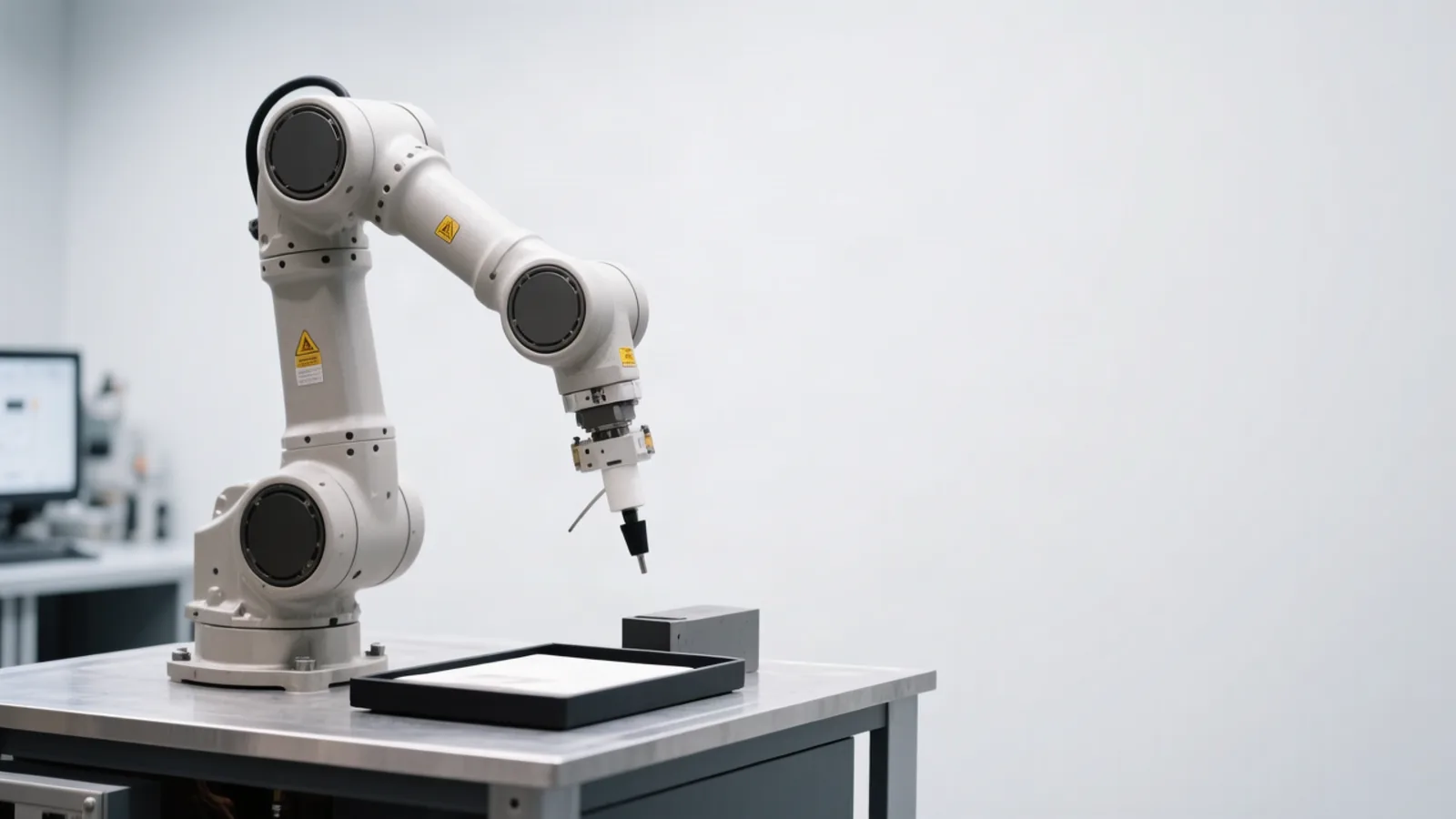
Runway has released the weights of Praxis-1, its 27-billion-parameter world action model for robot control, under the Apache 2.0 license, with the inference and fine-tuning code published alongside. A video-generation lab just handed robotics developers a fully licensable foundation model that runs on everything from an H100 down to an RTX 5090.
Key facts
- Praxis-1 is a 27B-parameter mixture-of-experts diffusion transformer that predicts video and robot actions together, released under Apache 2.0 including commercial use.
- Runway reports 46.2% success across 1,200 episodes on NVIDIA's RoboLab-120, against 42.9% for FLUX 3 Action, 36.8% for Cosmos3 Nano, and 28.0% for π0.5.
- The Robot Report notes the model ranks fifth overall on the RoboLab leaderboard, so Runway's "top-performing" claim applies to its own model class, not the whole board.
- The base checkpoint is 54.4 GB in bf16 across 17 safetensors shards, controlling at 15 Hz with 24-step action chunks.
- Runway says it runs out of the box on NVIDIA H100 and B200, workstation cards like the RTX 5090, and Jetson Thor on the robot itself.
What happened
Runway introduced Praxis-1 in September 2026 as its first world action model, built on the same large-scale video pretraining behind the company's general video models. At launch, it committed to releasing the model openly. That commitment is now met: the weights are on GitHub and Hugging Face, with native LeRobot support and inclusion in vLLM-Omni, plus hosted inference through the Reactor service.
The license terms are the story. Apache 2.0 covers the weights and the inference and fine-tuning code, expressly including commercial use. Fine-tuning supports both full fine-tunes and LoRA, so a team can adapt the model to its own robot bodies, cameras, and tasks without retraining all 27 billion parameters. According to the model card, the base checkpoint is a 27.2B-parameter MoE video-diffusion policy with a chunk-causal trunk and a 0.3B action expert.
Between the September announcement and this release, Runway's partners ran the model on their own hardware: a legged humanoid at Noble Machines, a six-axis industrial arm at Standard Bots, and a dual-arm warehouse robot at Ultra. Andy Chen, Runway's head of robotics, told The Robot Report that with Noble Machines the model learned a warehouse plank-picking task from half an hour of examples and completed it 15 times out of 15, then cleared an unseen, messy pile of planks into bins six times out of 10.
The benchmark numbers deserve their label. Runway reports 46.2% success on RoboLab-120, NVIDIA's evaluation suite, ahead of FLUX 3 Action at 42.9%, Cosmos3 Nano at 36.8%, and π0.5 at 28.0%. Those are vendor self-reports from Runway's own announcement, and we have not independently reproduced them. What would verify them is an independent run on the published checkpoint, which is exactly what the Apache 2.0 release makes possible. The Robot Report adds one caution Runway's page does not lead with: Praxis-1 ranks fifth overall on the RoboLab leaderboard. Its leadership claim holds within the world action model category and among open-weight end-to-end policies, not against every architecture NVIDIA tracks.
Why it matters
Robot control has been one of the least open corners of AI. Frontier robotics models mostly live inside closed labs or hardware-vendor stacks, and a team that wanted a modern manipulation policy usually had to accept someone else's API, someone else's hardware, or both. Praxis-1 is a different proposition: a frontier lab putting a robotics-adjacent foundation model under a permissive license with the full adaptation stack attached.
The hardware range matters as much as the license. A model that runs from H100-class data center cards down to a workstation RTX 5090 and onto Jetson Thor at the robot is a model a small lab can actually evaluate on hardware it owns. Combined with LeRobot integration, the open-source robotics stack maintained by Hugging Face's community, the release lowers the cost of experimenting with video-pretrained policies to roughly the cost of a high-end GPU and electricity.
There is also a supply-side signal here. Runway's research page argues that web video matches teleoperated robot video as pretraining data for policy performance. If that holds up, the bottleneck for capable robot policies shifts toward how much general video a lab can learn from, which is an asset video-generation companies hold in abundance. A video lab choosing full open licensing for a robotics model widens the set of workloads builders can self-host without touching a cloud API, the same pattern we have tracked across language model releases this year.
Background
World action models are a young category. Instead of mapping camera images directly to motor commands, a WAM learns to predict how a scene evolves and produces the actions that realize the prediction, keeping video prediction in the training objective all the way through. Chen's framing to The Robot Report is that the model "pictures what the scene should look like next and produces the motion that gets it there." The category has been dominated by NVIDIA's ecosystem work, including the Cosmos line, and by robotics labs like Physical Intelligence, whose π0.5 appears in Runway's comparison table.
The release also fits the broader open-weights cycle DeAI News has been following. In recent months we have covered Inkling's 2 Small Ripple 65B, Mistral's Large 4, and the steady accumulation of Apache 2.0 artifacts across language, coding, and now robotics. What distinguishes the robotics case is the license's practical reach: weights, serving code, and fine-tuning code under one permissive terms sheet is rarer in embodied AI than in text, where that combination is close to the default for serious open releases.
Runway situates the release geopolitically as well as technically. The company is a founding member of the Cosmos Coalition with NVIDIA, and Chen told The Robot Report that US competitiveness in physical AI depends on "interoperability and openness from American models that physical use cases don't have yet." Whether open weights do the work of industrial policy is a fair debate, but the intent is legible: make the American stack the one developers can inspect and adapt.
What's next
Runway says its focus now shifts from release to deployment: getting Praxis-1 into warehouses, factories, and industrial sites with its partners, then feeding what the model encounters back into future versions. For builders, the near-term checkpoints are concrete. Independent RoboLab-120 and SimplerEnv runs on the published weights would settle how much of the 46.2% claim survives outside Runway's own evaluation. Community fine-tunes and LoRA adapters on new embodiments should surface on Hugging Face within weeks, and the practical question of how the model behaves off the lab bench, on cheap cameras and messy warehouses, gets its first real answers as partner deployments scale. If you have been waiting for a robotics policy you could download, inspect, and fine-tune, the wait is over; what the community does with it starts now.
Questions
- What is Runway's Praxis-1?
- Praxis-1 is a 27-billion-parameter mixture-of-experts diffusion transformer that predicts video and robot actions together. Runway released the weights, inference code, and fine-tuning code under Apache 2.0, permitting commercial use.
- Can you run Praxis-1 on a single GPU?
- Runway says Praxis-1 runs out of the box on data center GPUs (H100, B200), workstation cards like the RTX 5090 and RTX PRO 6000, and NVIDIA's Jetson Thor on the robot itself. The bf16 checkpoint is about 54.4 GB.
- Is Praxis-1 the best robot control model?
- It depends which ranking you read. Runway says it is the top world action model on NVIDIA's RoboLab-120 leaderboard at 46.2% success. The Robot Report notes it ranks fifth overall on that leaderboard, so non-WAM architectures still score higher.
- What license is Praxis-1 under?
- Apache 2.0, including for commercial use. That covers the weights and both the inference and fine-tuning code, with support for full fine-tuning and LoRA adaptation.
Sources
- Praxis-1 Is Now Available: Open-Weight Robotics Model — Runway
- Runway's Praxis-1 world action model for robotics is now available — The Robot Report
- runwayml/praxis-1-base model card — Hugging Face
- Praxis-1: video pretraining to robot control (research) — Runway
About DeAI
DeAI is an independent publication covering open-weight AI models, private inference, and decentralized infrastructure — the tools for running AI you actually control. We test providers on price, privacy, and refusal behavior and publish the numbers, not the vibes. DeAI is powered by Morpheus (mor.org), a decentralized inference marketplace, and covers it on the same terms as every other provider.
Powered by Morpheus and StrandCMS
Morpheus is a decentralized inference marketplace, covered on the same terms as every other provider — we rank it wherever the data lands. StrandCMS is the open-source, agent-first framework this site is built on.