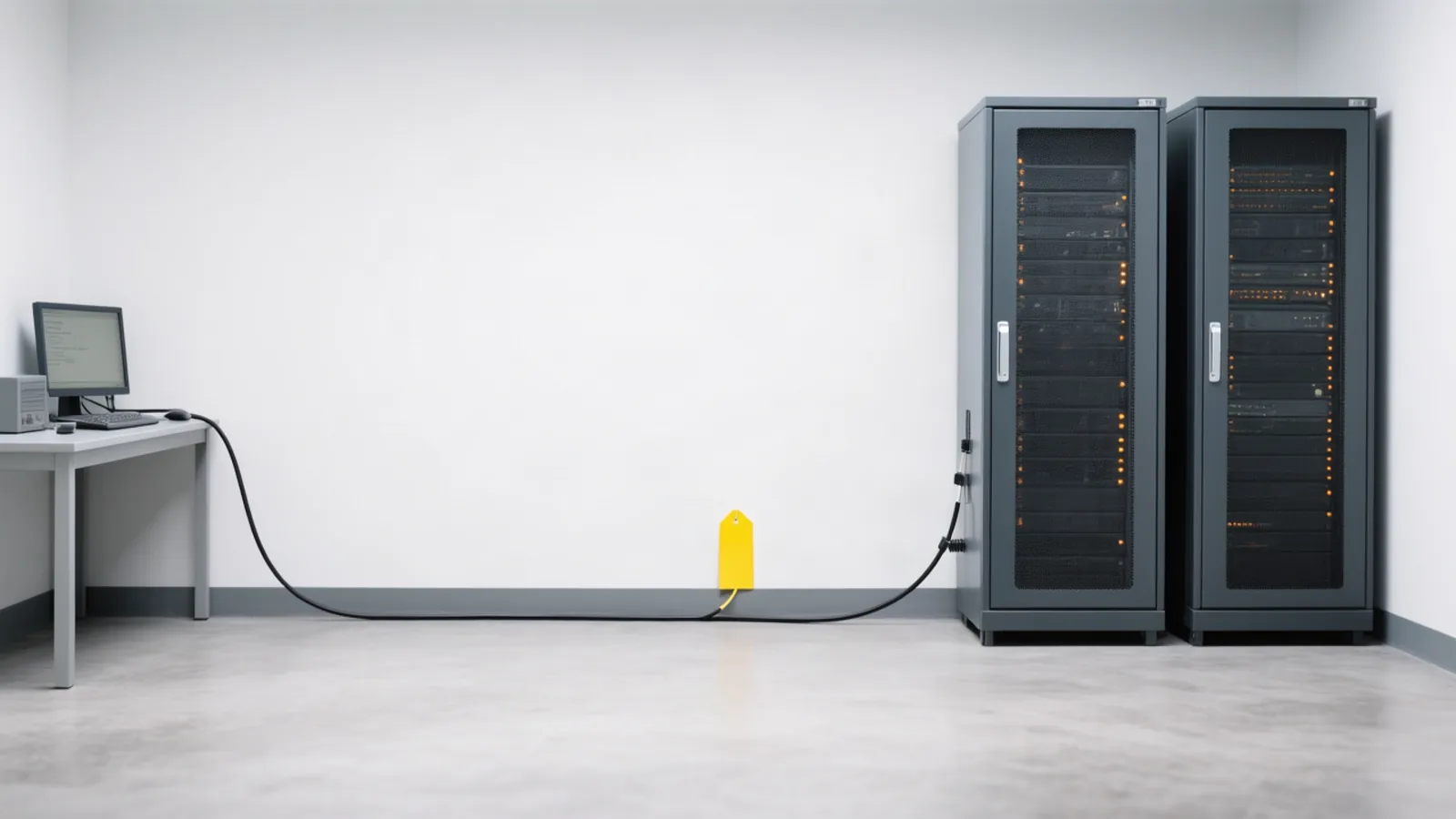
The week the prompt's journey got measured. HD Moore's team at Dragos published on November 19 the first large-scale empirical test of the inference supply chain's privacy layer: roughly two million prompts seeded with canary credentials over five months, and the findings are the blunt kind — three inference providers were actively compromised (none knew until told), marketplace resellers read customer prompts with ordinary logging tools, and one ZDR-flagged prompt sent to a US provider surfaced in a Feishu chat 24 days later, opened from devices in Beijing and Shanghai. The report's compression of the whole problem: a privacy flag only binds the first hop.
Around that spine, the week built out the counter-story. The routing layer consolidated: Hugging Face switched its language-model traffic to OpenRouter's router on November 16, and Nvidia's interim CEO used the first post-Huang earnings call to reaffirm the $12.9 billion Hugging Face acquisition and the open-model strategy. The open-weights shelf kept filling at both ends — Tencent's full Hy4 770B flagship (with a license that quietly walks back Apache 2.0 for large operators), Meituan's 1.6T LongCat-2.5 under MIT reportedly trained without Nvidia silicon, and a 2.3B browser model from Microsoft at the other extreme. Nine stories mattered; here is what each one changes.
Key facts
- ~2,000,000 prompts / 3 breaches — what Dragos seeded and found compromised between July and November 2026; stolen AWS keys drove tens of thousands of API calls, the earliest incident dates to mid-July, and none of the three providers knew until Dragos notified them.
- ~2/3 — the share of no-data-collection and Zero Data Retention-marked requests to one Chinese AI lab's models whose canary URLs the lab's systems fetched anyway, typically two or three days after the request.
- 71.7% — open-weight models' share of OpenRouter tokens served at the end of September 2026, per OpenRouter data cited in Hugging Face's announcement — up from 26.8% in October 2025, peaking at 77.5% in July.
- 770B / 49B active — Tencent Hy4's full flagship weights, published November 20 with FP8 and base variants and an 82-page system card, under a Hy License whose Section 10 adds MaaS terms absent from the August preview's Apache 2.0.
- 1.6T total / ~48B active / MIT — Meituan LongCat-2.5, a multimodal agent model whose training reportedly ran on Huawei Ascend accelerators and whose self-hosting guide covers only Ascend hardware; the Ascend-only claim is vendor-reported.
- $0.14/$0.42 — deepseek-v4.1-flash on OpenRouter's catalog after the November 16 index observation: input up 175% while output fell 26%, one of six rows that all scissored in opposite directions.
1. The canary experiment: three providers breached, ZDR flags ignored
The week's lead story is five months of fieldwork, published November 19 by HD Moore — the Metasploit creator, now Chief Research Officer at the industrial-security firm Dragos — and his team. They submitted about two million prompts to widely used AI services, each carrying a unique URL, DNS name, and a real AWS credential tied to an empty, fully logged account, so any use anywhere on the internet pointed back to the exact prompt, model, router, and privacy flag that carried it. Tokens started firing within days. The findings, in order of severity: attackers were actively stealing data at three inference providers — in the largest breach a couple hundred bait keys, each sent in exactly one request, were all stolen, including from requests the provider rejected before a model ran, which means the attacker was copying traffic at the front door; resellers on an inference marketplace read and retained customer prompts using standard logging, and in one case a French home-broadband attacker took passwords from two prompts and typed SSH root-login attempts by hand; and a Chinese AI lab's scraper fetched secret URLs from more than half the prompts sent to its models — including roughly two-thirds of the requests marked "no data collection" or ZDR, usually two or three days later, with US providers reselling that lab's models passing customer prompts into the same funnel. Why it matters: every privacy policy, TEE, and data-residency choice a builder makes binds only the first hop — and the report shows the rest of the chain leaking through compromise, through logging, and through a scraper that treats the flag as a suggestion. The report's recommendations are the actionable part: self-host where the work is sensitive, go first-tier rather than marketplace, pin your router's upstreams, and seed your own canaries. Full story.
2. Hugging Face outsourced its router to OpenRouter
The week's biggest plumbing change took effect November 16: language-model calls on Hugging Face's Inference Providers now route through OpenRouter, which picks a provider per request on live measurements of price, speed and reliability, retries on the next-best provider inside the same call, and keeps an ongoing conversation on the provider holding its prompt cache. Developers can still steer with model-ID suffixes — :fastest, :cheapest, or :provider to pin one backend — but the breaking change is keys: custom provider API keys no longer work for language-model calls, because those requests bill to your Hugging Face account through the OpenRouter path. Hugging Face adds no markup; PRO accounts get $2 in monthly credits. OpenRouter's own rebuilt router reported cutting capacity errors by 46% and improving time-to-first-token by 16.9% — its numbers, not an audit. Why it matters: a single Hugging Face token is now a live auction across 80+ providers, which arbitrages raw price differences away by default — so what stays sticky is exactly what the router cannot arbitrage: zero-retention terms, license conditions, regional hosting. The timing is not a coincidence: open-weight models carried 71.7% of OpenRouter's tokens at the end of September, up from 26.8% a year earlier, and the largest open-model distribution channel just wired itself into the largest open-model router. Full story.
3. Tencent shipped the full Hy4 — and the license walked back Apache 2.0
The loudest open-weights event of the week arrived in two parts. November 19 brought Hy4 flash: a 220B-parameter MoE with 12B active per token and a 1M-token context. November 20 brought the main event: full Hy4 flagship weights — 770B total, 49B active, natively multimodal, 1M context — plus Hy4-FP8, the pre-trained base, a GGUF build, and an 82-page system card. The numbers worth reading twice: community estimates put the FP8 checkpoint around 924GB (unverified, with a conflicting ~786GB figure in circulation), and Tencent's own vLLM recipe targets tensor-parallel 8x-class flagship GPU servers — this is a model you rent, not run at a desk. The part the celebration glossed over is the license: the Hy License is Apache-derived, but Section 10 requires a separate written license if a MaaS operator's aggregate gross revenue exceeds US$50M in any 12-month period or a product using the weights exceeds 100M monthly active users — a materially different proposition from the August preview's Apache 2.0, and one that applies to fine-tunes and distillations too. Every benchmark on the card (MMLU 91.6, SimpleQA 57.2) is Tencent's own self-report. Why it matters: frontier-scale weights with restrictive commercial terms attached is the pattern of the season, and the Section 10 threshold gives every large hosted provider a reason to negotiate rather than ship — which shapes who serves Hy4 at all. Full story.
4. Meituan's LongCat-2.5: 1.6T agent weights under MIT, reportedly Ascend-trained
The week's second frontier-scale release made the opposite licensing choice. Meituan's LongCat team published LongCat-2.5 — a 1.6-trillion-parameter multimodal MoE with about 48B active per token, built for long-horizon agent work — under the MIT license on Hugging Face, the most permissive mainstream license available: no usage caps, no revenue thresholds, no country restrictions. The self-reported benchmark table puts it at 88.4 on Terminal Bench v2.1 against Claude Opus 5's 89.1, and 91.9 on BrowseComp, the highest in its table — all vendor-run until reproduced. The hardware story is the part making industry noise: Meituan says training and long-context inference optimization ran on domestic Chinese accelerators with under 80GB of memory per device, and the self-hosting guide covers only Huawei Ascend Atlas A2 hardware (194 accelerators in the reference deployment), with no CUDA or ROCm instructions published. The launch API price is promotional — roughly €0.27 per million input tokens per THE DECODER's conversion. Why it matters: if the Ascend-only claim is accurate (it is a vendor report, not an audit), frontier-scale open weights optimized for Chinese silicon from the start are now a distinct engineering track — and MIT-licensed weights at this capability tier are the most forkable asset on the shelf. Full story.
5. Chutes ended subscriptions: the decentralized market's outlier billing is gone
Chutes, the largest inference subnet on the Bittensor network, stopped selling its monthly subscription plans and moved to pay-as-you-go credits. The team announced the change October 26 alongside two new beta models, Qwen3.8 Max and DeepSeek V4.1 Pro — both excluded from legacy plans and reachable only on usage billing, and neither currently supporting the platform's TEE, confidential-compute, or end-to-end encryption modes. The pricing page now states plainly: "Monthly plans are no longer sold on chutes.ai." The quoted reasoning — that under "current general GPU/compute market dynamics, subscriptions are no longer feasible" — reads as flat-rate economics catching up with input costs; the network had already admitted a 45% six-week volume drop in DeAI's tracker cycle 8. A 35% discount on two flagship models folds into the transition and expired November 23. Why it matters: the $3/$10/$20 tiers were the lowest-commitment on-ramp to a decentralized network and the outlier in a market that bills per token; their removal pushes every builder into the same posture as a conventional API account, and the missing TEE support on the new tier is the detail sensitive workloads should not skip. Full story.
6. Nvidia's interim CEO reaffirmed the Hugging Face deal — on the record, in one paragraph
The week's governance story had one job: remove the question mark. On the November 17 earnings call — the first since Jensen Huang resigned — interim CEO Colette Kress said Nvidia is "committed to fostering a vibrant open model ecosystem, so every country, company, and industry can build its own intelligence," and confirmed the $12.9 billion Hugging Face acquisition remains on track: "Together, we will scale its platform and make intelligence more open, more capable, and more accessible." She cited a 35-fold year-over-year rise in weekly OpenRouter token volume and called Nemotron the most widely used US open model on the router — both company-cited claims, not audited figures. The deal was not addressed in the analyst Q&A. The backdrop is heavier than the paragraph: the SEC is reportedly investigating Nvidia's disclosures, Huang has agreed to testify before Congress by Thanksgiving, and the neutrality commitment builders care about — "NVIDIA compute will not be required to build on or deploy through Hugging Face" — remains a promise on paper under leadership that has not yet been made permanent. Why it matters: the strategy survived its founder's exit in rhetoric; the test is whether the acquisition's open-platform commitments survive the deal's closing conditions. Full story.
7. The price index scissored: six rows, all in opposite directions
The ninth OpenRouter Price Index observation landed Monday with the week's cleanest market signal: six of seventeen tracked rows moved, and every single mover scissored — input and output legs going in opposite directions. deepseek-v4.1-flash jumped from $0.051/$0.567 to $0.14/$0.42 per million tokens (input +175%, output −26%); deepseek-v4-flash-0731 went to $0.06/$0.18; kimi-k2.5 fell to $0.50/$2.50, giving back most of the previous week's +33% output spike after exactly one observation; deepseek-v4-pro moved to $0.90/$1.50. One row passed a threshold worth noting: llama-4-maverick, up 87% on input the week before, held its new $0.35/$1.00 level for a second consecutive observation — the first upward move in this index to survive the two-observation test since issue two. No first-party price changes were verified for any of the movers. Why it matters: three consecutive weeks of mixed-direction, per-row movement is the strongest accumulating evidence that these are per-host experiments on aggregator rows rather than a market trend — and that list prices are increasingly the wrong mental model for what hosted open models actually cost. Full story.
8. Microsoft put open weights in the browser; Cloudflare put open weights on the edge
Two task-scale releases bracketed the week's big-model headlines. Microsoft published MIT-licensed weights for Aion 1.0 Instruct, a 2.3B-parameter model that is now Edge's built-in small language model, with a Prompt API moved to an origin trial on November 19 so live sites can prompt it from client-side JavaScript — and Microsoft says an optimized version becomes Windows' built-in model by end of January 2027. All the card's benchmarks (MMLU 55.15, IFEval 83.90) are Microsoft's own. Cloudflare, meanwhile, published full open weights for Clairic 27B and Clairic-flash 9B, task-specific document-extraction models hosted on Workers AI at $0.24 and $0.10 per million input tokens (billed input-only, promotional $0.10 until December 1) — its latency and accuracy tables are self-reported, as Cloudflare itself says. Why it matters: the open-weights story is no longer only about frontier models — it is now also the default distribution for small, task-specific models that live where the data already is, browser or edge, with pricing that sets a concrete benchmark against general-purpose API calls doing the same job. Aion Instruct, Clairic.
9. OpenAI wants reasoning traces unstealable — and the tracker logged another zero
Two entries on the verification spectrum closed the week. OpenAI published anti-distillation research on November 20 reporting that its internal red-team saw reasoning-trace extraction success fall from 54.0% to 0.2% between GPT-6 and GPT-6.2 Astra — a self-reported, unreproducible figure — while the verifiable mechanism underneath it is the real news: reasoning traces are now bound to the conversation that produced them and dropped if an earlier message is rewritten, which makes reasoning an API-managed asset and, for builders who depend on structured reasoning in tool calls, a new failure mode when output classifiers block requests. On the other end of the evidence bar, the tracker's eighth sweep cycle — published November 15 — appended 23 claimed entries to 13 providers and set a funnel record: 18 checks attempted a real observation and none produced usable evidence (nine Chutes probes rate-limited, four Venice probes access-gated), leaving the ledger at 127 entries with verified still at zero. Why it matters: the same week produced the field's most damning privacy measurement and its most careful null result, and they agree — claims about what providers do with your prompts and your traces are abundant, and independently verifiable facts remain scarce. Distillation defenses, sweep cycle 8.
Also on the tape
Five items that did not make the top nine but belong in your feed. DeAI priced Hyperbolic's relaunched inference API: 11 open models from $0.06/$0.18 (DeepSeek V4 Flash) to $3.00/$15.00 (Kimi K3), on a prepaid wallet, after the old serverless API was retired without notice in September. Akash's one-way AKT migration to Solana went live with mainnet contracts deployed — though the marketplace cutover that actually changes provider billing still needs a second governance vote. A community project called llama-modchip claims DeepSeek's 284B V4-Flash runs CPU-only on a 64GB machine at 9–14.7 tokens per second; the repo is public, the numbers are not reproduced. Runway shipped Praxis-1, a 27B robot-control model under Apache 2.0 that runs down to an RTX 5090 — with the caveat that its claimed top spot is among world action models specifically, fifth overall on NVIDIA's leaderboard. And Solana's Confidential Compute SDK put TEE attestation verification onchain in devnet beta — unaudited, GPU attestation still in progress.
The Friday hub, This Week in DeAI: The Router Week, ties the routing, licensing, and billing threads into the full arc with complete sourcing. Last week's edition: The 9 DeAI stories that mattered, week 46.
Questions
- Does Zero Data Retention actually stop prompts from leaking?
- Not always, according to the Dragos canary study published November 19. Of the prompts sent to one Chinese AI lab's models, roughly two-thirds of those marked no-data-collection or Zero Data Retention still triggered the lab's scraper, and one ZDR-flagged prompt sent to a US provider surfaced in a Feishu chat 24 days later. ZDR is a policy claim by the provider, not a technical guarantee you can verify from outside.
- What changed with Hugging Face Inference Providers on November 16?
- Language-model requests now route through OpenRouter instead of Hugging Face's own router. OpenRouter picks a provider per request on live price, speed and reliability, retries inside the same call, and keeps conversations on the provider holding the prompt cache. Custom provider API keys no longer work for language-model calls, though they survive for image and video.
- Is Tencent Hy4 really open weights?
- The weights of the 770B-total/49B-active multimodal flagship, its FP8 build, and the pre-trained base are downloadable from Hugging Face, ModelScope, and GitCode — plus an 82-page system card. But the Hy License is Apache-derived, not Apache 2.0: Section 10 requires a separate written license for MaaS operators above $50M gross revenue per 12 months or products above 100M monthly active users.
- Can you still subscribe to Chutes?
- No. Chutes stopped selling monthly subscriptions and moved to pay-as-you-go credits; existing plans run out at the end of their current billing period. Its two newest beta models, Qwen3.8 Max and DeepSeek V4.1 Pro, are PayGo-only and do not currently support the platform's TEE or confidential-compute modes.
Sources
- Three breaches, endless leaks: Your AI supply chain needs canaries — Dragos
- Hugging Face and OpenRouter join forces to make open-weight models easy to run — Hugging Face
- Open-weight vs closed-weight models on OpenRouter (October 2026 insights) — OpenRouter
- Tencent Hy4 model card (weights, license, deployment recipes) — Hugging Face
- Tencent Hy License v1.0 (LICENSE file, tencent/Hy4) — Hugging Face
- Introducing LongCat-2.5 (tech blog) — LongCat (Meituan)
- meituan-longcat/LongCat-2.5 model card — Hugging Face
- Chutes pricing page — model rates, Private Chutes, and billing FAQ — Chutes
- Nvidia says its open source AI strategy remains intact after Jensen Huang's exit — TechCrunch
- OpenRouter API — list models — OpenRouter
- microsoft/Aion-1.0-Instruct-2.3B model card — Hugging Face
- An updated Clairic and Clairic-flash are now open-weight — Cloudflare Blog
- Combatting adversarial distillation — OpenAI
About DeAI
DeAI is an independent publication covering open-weight AI models, private inference, and decentralized infrastructure — the tools for running AI you actually control. We test providers on price, privacy, and refusal behavior and publish the numbers, not the vibes. DeAI is powered by Morpheus (mor.org), a decentralized inference marketplace, and covers it on the same terms as every other provider.
Powered by Morpheus and StrandCMS
Morpheus is a decentralized inference marketplace, covered on the same terms as every other provider — we rank it wherever the data lands. StrandCMS is the open-source, agent-first framework this site is built on.